

You are driving through town, the message center flashes "Cleaning Exhaust Filter," and suddenly, your truck starts puffing smoke like an old steam locomotive.
You may ask: "Is this normal?"

The short answer is: Yes. It's a common issue for 6.4 Powerstroke, but not a healthy one.
While a slight haze is expected during regeneration, visible clouds of white, blue, or gray smoke indicate that the factory emissions strategy is struggling, and your engine may be at risk of Oil Dilution or Turbo Failure.
Here is the technical breakdown of why your truck smokes during regen and why the only permanent fix is to remove the regeneration cycle entirely.
1. The "Flamethrower" Strategy: Why It Smokes
To understand the smoke, you have to understand how the 2008-2010 6.4L Powerstroke diesels cleans its Diesel Particulate Filter (DPF).
-
Post-Injection: Unlike newer trucks that use a separate injector or DEF fluid, the 6.4L uses its main engine injectors to spray raw diesel fuel during the exhaust stroke.
-
The Goal: This raw fuel is supposed to travel down the exhaust pipe, ignite inside the DPF, and burn off the soot at 1,100°F+.
-
The Smoke Cause: If the DPF is heavily clogged, or if the temperatures aren't high enough (e.g., stop-and-go driving), that raw fuel doesn't burn cleanly. It vaporizes into White Smoke (raw diesel fuel vapor) or Black Smoke (partially burned soot).
| Smoke Color | Likely Cause During "Cleaning" | What It Means | Risk Level |
| White / Grey | Raw Unburnt Diesel | DPF is not hot enough to ignite the fuel spray. | ⚠️ High (Cylinder Washdown) |
| Blue / Blue-White | Burning Motor Oil | CCV system is dumping oil into hot turbo/exhaust. | 🚨 Critical (Turbo Seal Failure) |
| Black (Thick) | Clogged Soot | DPF is 99% full; engine is choking on backpressure. | ⚠️ Moderate (Hardware Restriction) |
| No Smoke | Optimized / Deleted | System removed; clean combustion. | ✅ Safe |
2. The Hidden Culprit: The CCV and Blue Smoke
If the smoke has a blue tint, the problem is likely your Crankcase Ventilation (CCV) system—a known weak point on 6.4L Powerstroke.
-
The Mechanism: The factory CCV routes oily crankcase gases back into the intake. This oil pools in the intercooler.
-
The Trigger: When regeneration starts, exhaust temperatures skyrocket. This heat can cause the accumulated oil in the system to burn off, creating dense clouds of blue smoke.
-
The Solution: A CCV Reroute Kit stops oil from entering your turbo/intake system, preventing this smoky mess and protecting your turbo compressor wheels.
3. The Real Danger: Cylinder Washdown & Oil Dilution
The biggest concern isn't the smoke itself—it's what is happening inside the engine block while it's smoking.
-
Washing the Walls: When the injectors spray that extra fuel for regeneration, some of it misses the exhaust valve and hits the cylinder walls. This washes away the protective oil film, causing accelerated ring wear.
-
Making Oil: That fuel then drips down past the rings and into your oil pan. This is called Fuel Dilution.
-
The Result: Your oil level rises, but the oil becomes thin and watery. This leads to spun bearings and catastrophic engine failure—one unneglectable killer of 6.4L Powerstroke. While this won't happen right at this very second, it's still hazardous under ongoing regen cycle.

4. One Possible Fix: Stop the Cycle
You cannot "repair" a design flaw. As long as the truck enters "Cleaning Exhaust Filter" mode, it will dump raw fuel into your engine and exhaust.
To stop the smoke and protect your engine, you need a Full Reliability Bundle:
-
Exhaust Upgrade: Replacing the DPF with a high-flow stainless steel pipe physically removes the cork that traps soot.
-
Tuning (The Brain): A tuner (like the Mini Maxx V2) reprograms the ECU to disable the "Post-Injection" strategy.
-
Result: No more "Cleaning Exhaust Filter" messages. No more raw fuel dumping. No more smoke.
-
-
EGR & CCV: Blocking the EGR and rerouting the CCV ensures that the air entering your engine is clean and oil-free, further reducing smoke output.
| Metric | During Factory Regen Cycle | With Full Reliability Bundle |
| Fuel Economy | Drops to 6 - 8 MPG (Dumping fuel) | Constant 15 - 18 MPG |
| EGT (Exhaust Temp) | Spikes to 1,200°F - 1,400°F | Stays cooler (700°F - 900°F) |
| Throttle Response | Sluggish / Laggy | Instant / Responsive |
| Oil Life | Diluted with fuel (Change every 3k miles) | Clean (Standard 5k-7k intervals) |
Conclusion: Don't Ignore the Smoke
If your 6.4L Powerstroke is smoking during regeneration, you shouldn't neglect it. It's a sign that emissions system is overwhelmed and that fuel is likely diluting your engine oil.
Don't wait for the smoke to turn into a "Low Oil Pressure" warning. Optimizing the exhaust and ventilation systems is one possible way to turn a smoky 6.4L Powerstroke into a clean, reliable powerhouse.
Next Step: Tired of the white smoke and worried about your oil? Check out our 6.4L Powerstroke All-In-One Reliability Kit, includes exhaust, Tuner, EGR solution, and CCV Reroute to fix it all at once.
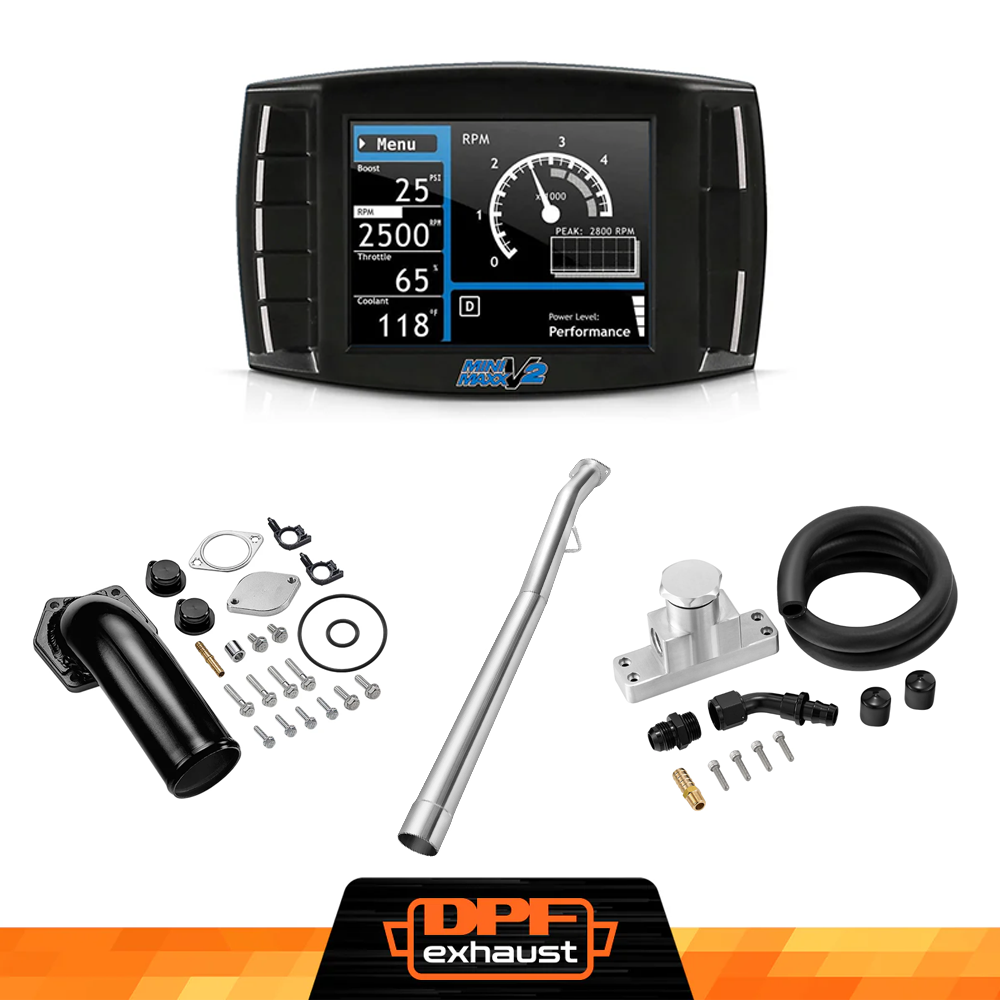
Designed to remove the failure-prone factory emissions systems that are known to cause catastrophic engine damage.
Upgrade Your Ford Today


