

6.7 Powerstroke Diesel Performance Oil Catch Can Kits
DPFexhaust Team | June 2026 | 6 min read
What an Oil Catch Can Does for Your 6.7 Powerstroke
An oil catch can kit is a simple mechanical device installed in the crankcase ventilation (CCV) line of your 6.7L Powerstroke engine. Its job is to intercept the oil mist and vapors that normally travel from the engine's crankcase back into the intake air stream, separate the oil from those vapors, and collect it in a reservoir rather than letting it coat the inside of your intercooler pipes, throttle body, intake manifold, and turbocharger compressor wheel.
The factory CCV system on the 6.7 Powerstroke routes blow-by gases through an oil separator inside the valve cover before feeding them into the intake inlet ahead of the turbo. The stock separator works reasonably well when the engine is new, but over time its internal baffles lose efficiency and more oil vapor slips past. That oil accumulates in the charge-air cooling system as a sticky film that attracts dirt, reduces intercooler heat transfer efficiency, and in some cases pools low enough in the piping to form measurable puddles. A well-designed 6.7 powerstroke oil catch can addresses this at the source by providing superior oil separation before any vapor reaches the intake path.
Discussions About Crankcase Oil on 6.7 Powerstroke
The following threads are owner experiences with crankcase oil entering the intake and intercooler systems on the 6.7L platform, and the problems that a 6.7 Powerstroke catch can designed to address.
Discussion 1 -- Oil Pooled in Throttle Body During Intercooler Tube Replacement
A Ford Truck owner documented what they found while replacing the intercooler tube on their 6.7L Powerstroke. After removing the old tube, they discovered oil had not simply coated the interior surface -- it had pooled in enough quantity to collect at the bottom of the throttle body housing and was coating the air temperature sensor as well.
"Replacing my intercooler tube and found a bit of oil puddled in the throttle body, coating the sensor, the inside of the old tube and opening of the intercooler." -- Ford Truck Enthusiasts Forums member, 6.7L Power Stroke owner
This is the classic symptom of an overloaded or aging factory CCV oil separator. The amount of oil described here goes well beyond a light film and indicates that the stock separation system is no longer keeping pace with crankcase blow-by volume, especially under sustained boost conditions where pressure differential across the CCV passage is highest.
Discussion 2 -- Whether Oil in Intercooler Piping Is Normal or a Problem
Over on Powerstroke Nation, an owner asked whether the persistent oil presence they were seeing in their intercooler hot-side piping warranted concern or intervention. The response from experienced members highlighted that this is widely accepted as normal behavior for the stock CCV configuration -- meaning the problem is not abnormal, but the design itself accepts ongoing oil ingestion as an operating characteristic rather than something to fully prevent.
"Oil in the intercooler is going to stay. If you're worried, just clean the hot side pipe really good. The oil in there is because the CCV goes right into the intake tube and gets sucked through the turbo." -- Powerstroke owner
The key takeaway is that oil in the intercooler piping on a stock 6.7 Powerstroke is expected behavior, not a malfunction. Owners who want to reduce or eliminate it need to modify the CCV path.
Discussion 3 -- Failed CCV System on 2011--2016 Models: Replace or Reroute?
A Powerstroke.org discussion focused specifically on the earlier 2011--2016 6.7L engines, where the factory CCV oil separator has a higher failure rate than the revised 2017+ design.
"For the 11-16 6.7 PSD with a failed CCV system, the best thing to do would be to replace it or reroute it. A reroute kit prevents oil droplets from re-entering the intake altogether." -- Powerstroke.org member
How to Maintain Your Stock CCV System?
If you want to keep the factory crankcase ventilation configuration intact and minimize oil carryover into the intake through proper care, the following steps address the most common causes of excess oil in the charge-air system.
Step 1: Inspect and Clean the Stock Valve Cover Oil Separator
Remove the engine cover and locate the CCV oil separator assembly mounted inside the valve cover. On high-mileage 2011-2016 models especially, check whether the internal baffle material has degraded, collapsed, or become oil-saturated to the point where it no longer separates effectively. If the separator appears intact but oily, remove it and wash it with a degreaser solvent. On models where the separator is a non-serviceable molded component integrated into the valve cover, visual inspection for cracks or dislodged positioning.
Step 2: Check Crankcase Pressure and PCV Operation
Excessive crankcase pressure forces more blow-by volume through the CCV system than separator can handle, which directly increases oil carryover. Use a crankcase pressure gauge to verify that idle pressure stays within specification (typically below 1--2 inches of water column at warm idle). Elevated readings may indicate worn piston rings, stuck piston rings, or restricted crankcase breather passages elsewhere in the engine. Addressing the root cause of high crankcase pressure will reduce the load placed on the oil separator and cut down on how much oil makes it into the intake.
Step 3: Clean Intercooler Pipes and Inspect Boot Seals Regularly
Even with a perfectly functioning CCV system, some oil film will accumulate in the intercooler piping over time. Every 30,000 to 40,000 miles, remove the hot-side and cold-side intercooler pipes, wipe out any pooled oil with lint-free rags and a suitable solvent, and inspect the rubber boots at each coupling point. Oil residue degrades rubber boot seals over time and creates leak paths that show up first as oily residue around the coupler edges. Replacing softened or swollen boots proactively prevents boost leaks.
Step 4: Monitor Oil Level and Change Intervals
Overfilled oil levels increase the amount of oil mist present in crankcase vapors because the spinning crankshaft counterweights contact a larger surface area of oil in the pan. Always fill to the correct level indicated on the dipstick. Additionally, follow the severe-service oil change interval if your driving includes frequent idling, short trips, or heavy towing.
These four steps represent the complete maintenance approach for minimizing oil in the intake on a completely stock 6.7 Powerstroke. They will significantly reduce oil carryover.
6.7 Powerstroke CCV Reroute and Oil Catch Can Kits Available at DPFexhaust.com
For owners who want to go beyond routine maintenance and eliminate oil vapor entry into the intake system, consider installing a CCV reroute kit with an integrated catch can. A reroute redirects crankcase gases away from intake inlet and routes them through a high-efficiency oil separator (the catch can) before either venting to atmosphere or returning cleaned vapor downstream. Below are the two primary options currently offered at DPFexhaust.com, covering both 360 degree rotatable elbow design and fixed elbow design configurations for 2011--2025 Ford Super Duty trucks with the 6.7L Powerstroke diesel engine.
Standard CCV Reroute/Delete Kit with Internal & External Catch Can
2011--2024 Ford F250 / F350 / F450 / F550 6.7L Powerstroke
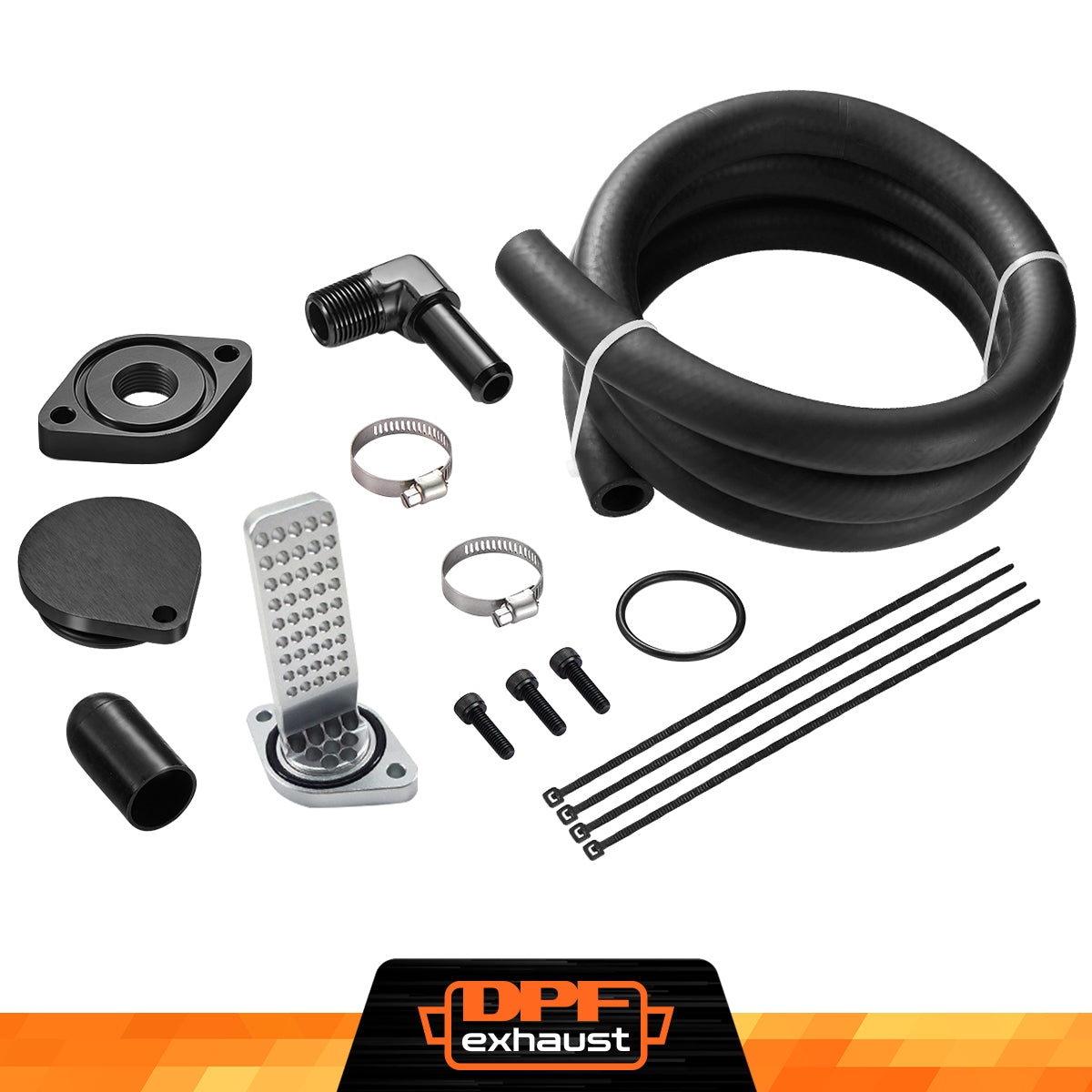
- Venturi-style high-efficiency design minimizes airflow restriction while preventing oil drips and pooling
- Reroutes crankcase oil vapors away from the intake system to prevent sludge and carbon buildup on turbo and intercooler surfaces
- Includes both internal filter element and external catch can reservoir for maximum oil separation capacity
- Built with 3/4-inch reinforced heat-resistant silicone hose (6-foot length) and anodized corrosion-resistant metal fittings
- Diy-friendly bolt-on installation requiring approximately 1 to 3 hours with basic hand tools
Upgraded CCV Reroute Kit with Internal & External Catch Can
2011--2025 Ford F250 / F350 / F450 6.7L Powerstroke
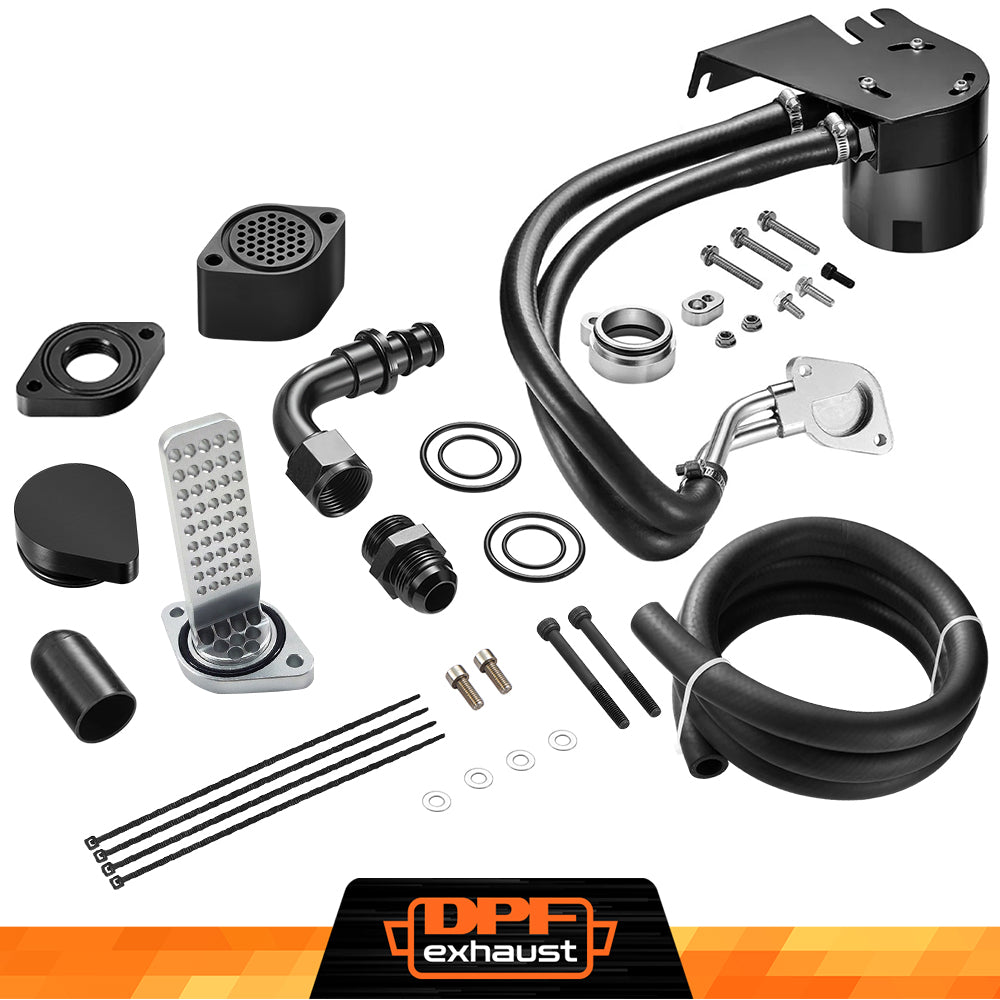
- 360-degree rotatable elbow allows precise adjustment of hose routing for optimal fitment in any engine bay configuration
- High-efficiency baffle system offers up to 100% oil molecule removal rate depending on selected filtration density option
- Maintenance-free internal catch can auto-drains separated oil back to the oil pan when the engine shuts off -- no manual emptying required
- Unrestricted airflow design ensures zero power loss and minimal pressure drop even under heavy boost conditions
- Reduces oil vapor odors entering the cabin and helps maintain cleaner combustion for improved fuel economy
Both kits are designed as bolt-on solutions for redirecting crankcase ventilation flow and intercepting oil vapor before it reaches your intake system. The Standard kit delivers reliable separation at an accessible price point, while the Upgraded kit adds enhanced filtration efficiency, auto-drain convenience, and extended fitment coverage through the 2025 model year. For questions about which configuration best matches your driving habits, truck usage pattern, or year-specific fitment concerns, contact service@dpfexhaust.com before ordering -- the team typically responds within 24 hours.


